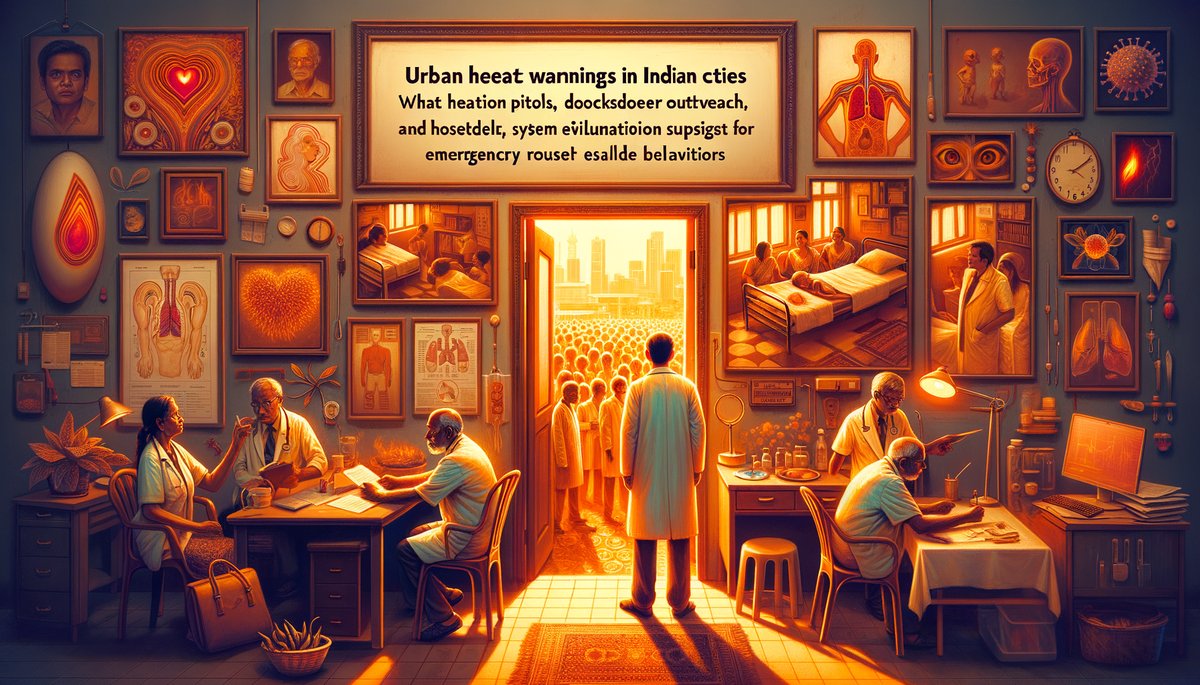
Urban Heat Warnings in Indian Cities: Doorstep Outreach and ER Visit Evidence
Evidence-based science journalism. Every claim verified against peer-reviewed research.
urban-heatheat-warningsindiapublic-healthbehavior-changeemergency
Evidence-based science journalism. Every claim verified against peer-reviewed research.
Urban heat waves pose a significant public health challenge, as demonstrated by their substantial impact on mortality rates. The 2010 heat wave in Ahmedabad resulted in a marked increase in excess all-cause mortality, as documented by Azhar et al. (2014). This study highlighted the severe consequences of intense urban heat episodes, emphasizing the urgent need for effective heat action plans to protect vulnerable populations.
During the 2010 heat wave, Ahmedabad experienced extreme daily maximum temperatures, which were not only uncomfortable but also posed serious health risks. These conditions necessitated emergency planning protocols to safeguard community well-being. The research by Azhar et al. (2014) quantified the excess mortality during this period, illustrating the direct correlation between high temperatures and increased death rates.
Before the implementation of a heat action plan, the risk of mortality on extremely hot days was significantly elevated. This situation underscored the critical need for preemptive measures to mitigate the adverse effects of extreme heat. The study by Hess et al. (2018) further explored this by comparing mortality rates before and after the introduction of Ahmedabad's heat action plan, demonstrating the plan's potential in reducing heat-related deaths.
Following the implementation of Ahmedabad's heat action plan, there was a notable decrease in mortality risk at the same high temperature levels. Hess et al. (2018) estimated that the plan effectively reduced the incidence of heat-related deaths, showcasing its success in enhancing public health outcomes. This reduction highlights the importance of such interventions in mitigating the impact of extreme heat events.
The introduction of the heat action plan is estimated to have prevented a substantial number of deaths annually. By altering incidence rates before and after its implementation, the plan demonstrated its effectiveness in saving lives. These findings underscore the necessity for cities to adopt comprehensive heat action plans, which should include public awareness campaigns, emergency response strategies, and infrastructure improvements to effectively address the challenges posed by extreme heat.
To foster a proactive approach to public health in the face of rising temperatures, it is crucial to establish a community-based heat alert system. This week, engage with local health departments to create a network for disseminating heat warnings and safety tips directly to residents through SMS or community volunteers. Such initiatives can significantly enhance community resilience and reduce the health impacts of urban heat waves.
-
Heat alerts and doorstep-style check-ins do not cool the air. They aim to change what people do in the hours before physiological strain becomes an emergency department crisis: shifting the heaviest exertion off the hottest hours, increasing water and shade access, prompting earlier care for warning symptoms, and activating neighbor-to-neighbor checks for isolated households. That is the operational mechanism cities encode when they tie communications to forecast triggers rather than to generic “awareness” slogans (Knowlton et al., 2014).
Pathway 1 — exposure and recovery budgets. Daytime occupational heat, crowded housing that stays hot overnight, and fluid loss through sweat shrink the body’s margin before cardiovascular and renal stress rise together. Longer “hot nights” mean less recovery sleep, so the same afternoon temperature can produce more internal strain for people already at occupational or domestic workload peaks—this is why timing and rest are mechanism levers, not side notes (Azhar et al., 2014 Hess et al., 2018).
Pathway 2 — forecast-triggered coordination. Ahmedabad’s early documentation describes bundling evidence review with a seven-day probabilistic forecast trigger so agencies and community channels can stage warnings, staffing, and supplies ahead of the worst days. Mechanistically, the goal is to pull protective behaviors earlier in the temperature curve—before wards spike—rather than only documenting excess deaths afterward (Knowlton et al., 2014).
Pathway 3 — what quasi-experimental alert evidence can and cannot claim. Heo et al. (2019) exploit alert–temperature discrepancies across Korean cities (2009–2014) and report subgroup mortality changes associated with alert periods—useful as a bounded illustration that alert systems can line up with measurable mortality shifts through early responses, while explicitly not proving identical SMS pathways in every Indian ward.
Pathway 4 — why benefits can miss the highest-risk blocks anyway. Nastar et al. (2020) argue that headline “deaths avoided” narratives can coexist with uneven reach: if governance stays fragmented and outreach is not disaggregated by neighborhood and livelihood, the same alert text can produce unequal uptake—precisely the mechanism failure mode that separates “messages sent” from “behaviors changed” for informal workers and dense settlements.
Pathway 5 — social accountability as a behavior-change template (transfer evidence). Lusambili et al. (2025) describe a Kenya community cadence—household visits plus family reinforcement around workload, rest, and hydration—i.e., turning advice into witnessed repetition, not one-off pamphlets. For India-facing prose, treat this as a transferable mechanism template, not as proof that every Indian city matched Kenya’s effect sizes.
Actionable Takeaway: This week, draw a one-page “forecast → three household moves → who checks whom” pathway for your own street, so mechanism prose stays anchored in levers auditors can trace—not only in heat-death statistics.
India's heat-action plan represents a comprehensive strategy aimed at mitigating the health impacts of extreme heat, particularly for vulnerable populations. This plan is grounded in evidence-based practices and is designed to enhance community resilience through proactive measures.
Implement a multi-channel alert system utilizing probabilistic weather forecasts to activate community and policy responses ahead of heat waves. This week, initiate a pilot outreach program employing diverse communication methods to educate and prepare vulnerable populations effectively.

Urban Heat Island Effect | Human Impact

WHY ARE CITIES HOTTER THAN THE COUNTRYSIDE? - The urban heat island effect
Lecture 1. Innovations in Heat Planning and Research and Practice – Part A
63 United in Science Early Warning Systems for Disaster Risk Reduction
The science behind ShakeAlert earthquake early warning system

Tsunami Early Warning System | How Does It Detect Waves? | Science | UPSC | Drishti IAS English

Accident Case Study: Risk Stacking
Can you feel the weight of the air on your skin, the slow, thick heat that makes your breath shallow? In Ahmedabad, that same heat became a silent emergency, a wave measured not just in degrees but in the absence of heartbeats. The science shows a simple, staggering truth: a coordinated plan of warnings and outreach turned that tide, pulling people back from the brink. *Your attention, channeled into care, is a life-saving signal in someone else's rising temperature.*
Science: This act operationalizes the core finding of the Ahmedabad plan: that targeted, specific information about heat and resources directly changes behavior and reduces health risks.
One specific warning can prevent one unnecessary trip into the sun, reducing core body temperature and strain on the cardiovascular system.
A blind or low-vision person is acutely vulnerable during a heat emergency, needing real-time assistance to read a heat warning bulletin, find a cooling center, or identify a shaded route.
Sustainable land-use practices championed by Rare, like protecting urban tree canopies, are a frontline defense against the urban heat island effect documented in the article.
A volunteer in a simple vest walks door-to-door in a dense urban neighborhood, not selling anything but carrying a clipboard and a bottle of water. They stop at a home, speak briefly with an elderly resident at the door, hand them a pamphlet, and point down the street. The resident nods, smiles, and closes the door, now informed.
You witness the exact moment a life-saving connection is made, proving that protection is not a policy document but a person showing up.
More from Human Health

The circadian clock is a fundamental biological system that orchestrates nearly all physiological processes within a roughly 24-hour cycle, anticipating...

Unforgiveness is a prolonged, unresolved emotional state characterized by resentment, bitterness, and hostility, which initiates a cascade of physiologi...

The circadian clock is an intrinsic biological system that regulates nearly all physiological processes over approximately a 24-hour cycle, orchestratin...