Water Pollution: From Rivers to Oceans
Evidence-based science journalism. Every claim verified against peer-reviewed research.
water pollutionenvironmentconservationoceansustainability
Evidence-based science journalism. Every claim verified against peer-reviewed research.
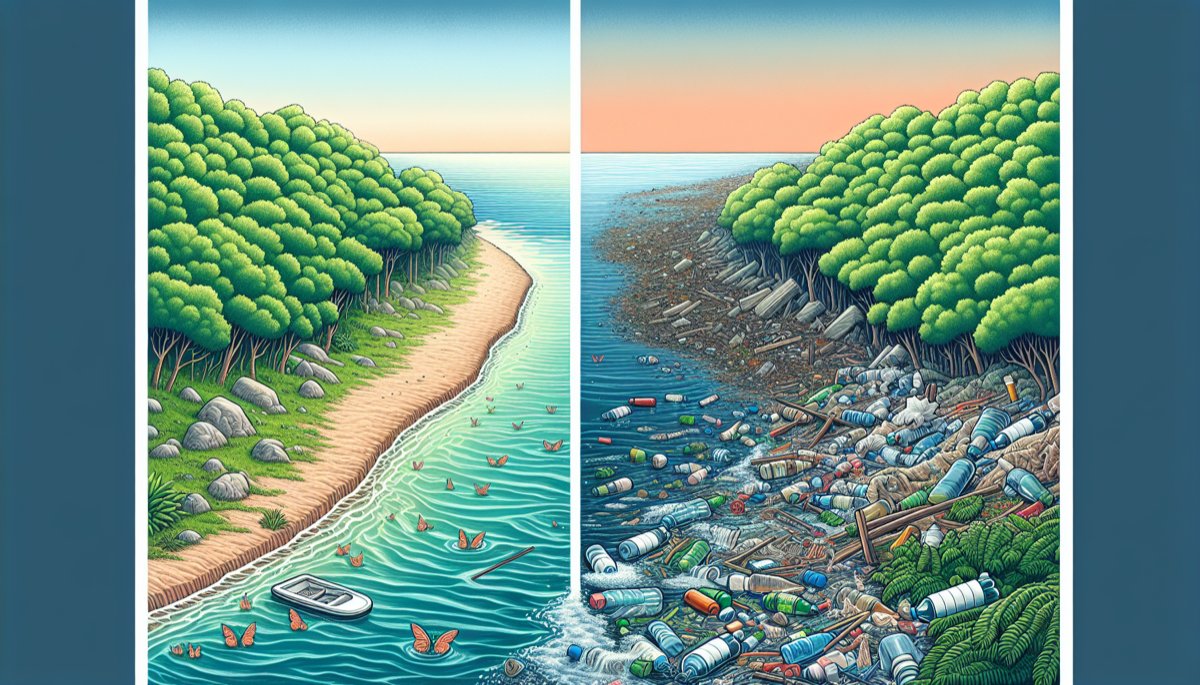
Every river is a conveyor belt. Pesticides sprayed on fields, pharmaceuticals flushed down toilets, microplastics shed from synthetic clothing — all enter waterways and travel downstream. By the time they reach the coast, these pollutants have accumulated through entire drainage basins.
Jambeck et al. (2015) in Science quantified that 4.8-12.7 million metric tonnes of plastic enter the ocean annually from coastal populations alone. But plastic is just the visible fraction. The invisible threat — dissolved chemicals — is far more insidious.
PFAS (per- and polyfluoroalkyl substances) are synthetic chemicals that do not break down in the environment. They persist in water, soil, and living tissue for decades. Found in non-stick cookware, waterproof clothing, and firefighting foam, PFAS are now detectable in the blood of 98%% of Americans and in rainwater worldwide.
Schwarzenbach et al. (2006) in Science established that micropollutants — pharmaceuticals, hormones, and synthetic chemicals — persist in water at concentrations that disrupt endocrine systems in fish, amphibians, and potentially humans.
When excess nitrogen and phosphorus from agricultural runoff enter waterways, they trigger algal blooms. When these algae die, bacteria consume the oxygen in the water as they decompose the organic matter. The result: hypoxic zones where dissolved oxygen drops below 2 mg/L — too low for fish, shrimp, or most marine life.
There are now over 700 documented dead zones worldwide. The Gulf of Mexico dead zone, fed by Mississippi River agricultural runoff, covers an area the size of New Jersey every summer.
Pollutants do not just dilute in water. They concentrate in living tissue. A small fish absorbs mercury from water and food. A larger fish eats hundreds of small fish, concentrating the mercury further. By the time a top predator (tuna, swordfish, human) consumes the fish, mercury levels can be millions of times higher than ambient water concentrations.
This biomagnification through trophic levels means that even trace-level pollution at the source becomes dangerous at the top of the food chain.
Riparian buffers — vegetated strips along waterways — remove 50-90%% of nitrates before they reach rivers through microbial denitrification in root zones. Constructed wetlands remove up to 99%% of pathogens through UV exposure and microbial antagonism.
Vörösmarty et al. (2010) in Nature showed that 80%% of the world's population lives in areas where river water security is threatened. The solution is not more treatment plants — it is restoring the biological filtration systems that rivers evolved over millions of years.
Nutrient runoff from rivers fuels coastal algal blooms that disrupt the biological carbon pump. When excess nutrients cause eutrophication in coastal waters, the resulting dead zones shift microbial metabolism from aerobic (oxygen-producing) to anaerobic (methane-producing) — turning carbon sinks into carbon sources.
What we put on land does not stay on land. Every molecule that enters a river eventually reaches the ocean's oxygen factory.
PFAS (per- and polyfluoroalkyl substances) contain the strongest bond in organic chemistry: the carbon-fluorine bond. No natural process on Earth can break it. Cousins et al. (2022) in Environmental Science and Technology proved that PFAS contamination has exceeded the planetary boundary — rainwater globally now exceeds safe drinking water guidelines.
Found in non-stick cookware, waterproof clothing, firefighting foam, and food packaging, PFAS are now detectable in the blood of 98%% of Americans. Their biological half-life in the human body is 3-7 years. They bioaccumulate through trophic levels, meaning top predators (including humans) carry the highest concentrations.
Floating plastic is not inert waste. Zettler et al. (2013) discovered the Plastisphere — a unique microbial ecosystem that colonizes plastic debris within hours of entering water. This biofilm includes potential pathogens, antibiotic-resistant bacteria, and invasive species that hitchhike across ocean basins.
Plastic surfaces select for microbes that can metabolize hydrocarbons, concentrating pollutant-degrading but also pathogenic species. A single plastic bottle can carry Vibrio species across continents. The marine biological pump is disrupted not just by the physical presence of microplastics but by the biological communities they transport.
Colborn et al. (1993) established that synthetic chemicals at concentrations as low as 0.1 nanograms per liter can disrupt hormonal signaling. Kidd et al. (2007) proved this experimentally: adding ethinyl estradiol at 5 ng/L to a whole lake caused complete reproductive failure and near-extinction of fathead minnows within 3 years.
Wastewater treatment plants typically discharge 1-10 ng/L of synthetic estrogens — well above the effective biological threshold. These chemicals are not removed by standard treatment. Only advanced oxidation or activated carbon can reduce concentrations, and most treatment plants worldwide lack these technologies.
A single nitrogen atom from agricultural fertilizer can cause a chain of damage: nitrate contamination of groundwater, eutrophication of rivers, ocean dead zones via algal bloom decay, and atmospheric nitrous oxide (N2O) emissions — a greenhouse gas 300 times more potent than CO2.
Agriculture is the source of 80%% of reactive nitrogen entering the environment. The Haber-Bosch process that feeds half the world's population also produces the nitrogen surplus that kills aquatic ecosystems. Riparian buffers and constructed wetlands are the most cost-effective solutions — wetlands sized at 5%% of watershed area remove 90%% of nitrogen (Cheng and Basu 2017).
Nutrient runoff from the soil fuels coastal algal blooms that create dead zones, threatening the marine biological pump. Microplastics shed from synthetic clothing enter rivers and disrupt the plankton that produce every second breath. Pesticides running off farmland kill the pollinators that nest near waterways.
Every molecule that enters a river eventually reaches the ocean. Water is the circulatory system of the planet — and right now, it is carrying the toxins of industrial civilization directly into the systems that keep us alive.
A common error in environmental policy is assuming that stopping a discharge immediately stops the pollution. Watersheds possess legacy memory. Phosphorus and heavy metals like lead exhibit high sorption affinity for soil particles. During heavy rain events, these old pollutants are liberated from sediments and re-enter the stream.
This is why a river can show high toxicity levels even years after a factory has closed. We are not just fighting current emissions — we are managing decadal accumulation. The hyporheic zone, the saturated sediment under the riverbed, acts as both a filter and a reservoir. Up to 90%% of a river's metabolism occurs in this zone. In urbanized rivers where we concrete the riverbed, we effectively lobotomize the river's ability to process chemical loads.
As nitrogen moves downstream, it undergoes a three-stage microbial handshake. Ammonification converts organic waste into ammonium. Nitrification by specialist bacteria (Nitrosomonas, Nitrobacter) oxidizes ammonium into nitrate — this process is oxygen-intensive and halts in hypoxic rivers. Denitrification in the oxygen-poor hyporheic zone converts nitrate into nitrogen gas that escapes into the air microbiome.
The efficiency of this spiral is measured by nutrient spiraling length — the distance a nitrogen atom travels before being captured, transformed, and released. In a healthy river, the spiral is short. In a polluted, overloaded system, it stretches for hundreds of kilometers, pushing pollution into the marine biological pump.
Agriculture contributes 55%% of nitrogen and 47%% of phosphorus loading in major river basins. Urban stormwater creates flash contaminant loads — the first 15-30 minutes of heavy rain carries 90%% of accumulated road pollutants. Atmospheric deposition accounts for over 50%% of mercury in some lakes and up to 25%% of nitrogen in coastal estuaries.
This means water pollution cannot be solved by targeting factories alone. It requires landscape-scale transformation: regenerative agriculture to reduce nutrient runoff, riparian buffers to intercept pollutants, and urban green infrastructure to absorb stormwater before it reaches rivers.
Pruden et al. (2006) established that antibiotic resistance genes (ARGs) are emerging contaminants in aquatic systems. Wastewater treatment plants concentrate ARGs from human waste. Effluent discharge increases downstream ARG abundance by 100 to 1,000 fold. The treatment process selects for resistant bacteria that survive chlorination.
Zhang et al. (2022) in Nature Water demonstrated that wastewater plants act as amplification hubs. Horizontal gene transfer occurs 10-100 times faster in biofilms within treatment infrastructure. Even sub-lethal antibiotic levels accelerate resistance spread. The soil microbiome receives these genes through sewage sludge application.
Cozar et al. (2014) in PNAS surveyed the global ocean surface. They found 99%% of plastic particles are smaller than 5 millimeters. However, 80%% of total plastic mass is in particles larger than 5 millimeters. This mismatch reveals a fundamental puzzle — large plastic enters at known rates but the surface contains far less than models predict.
Ter Halle et al. (2016) proposed fragmentation into nanoplastics as the explanation. Nanoplastics below 1 micrometer are invisible to current sampling methods. They may have already dispersed throughout the water column and can cross biological membranes. The marine microbiome interacts with this cascade through plastisphere biofilm formation.
Hurley et al. (2018) in Nature Geoscience demonstrated that river sediments contain 1,000 times more microplastic than the overlying water column. Sediments act as sinks during low-flow periods. During flood events, stored plastic resuspends — flow velocity increases 10-fold, releasing buried particles back into the water column.
This creates episodic pulses that bypass monitoring programs. Source reduction will not produce immediate water quality improvements because the sediment reservoir continues releasing stored microplastics for years or decades after inputs stop.
Kidd et al. (2007) conducted the definitive experiment: adding ethinyl estradiol at just 5 nanograms per liter to a whole lake caused complete reproductive failure and near-extinction of fathead minnows within 3 years. Wastewater treatment plants discharge 1-10 ng/L of synthetic estrogens — well above the biological threshold.
Antidepressants in river water alter fish predator-avoidance behavior. Intersex fish — males carrying eggs — are documented in rivers worldwide. These chemicals work at concentrations so low that standard treatment cannot remove them. The holobiont is affected too: endocrine disruptors in drinking water may modulate human gut bacteria that regulate hormone metabolism.
Who is polluting the ocean with plastic?

POWERFUL VIDEO: Why We Need to Stop Plastic Pollution in Our Oceans FOR GOOD | Oceana
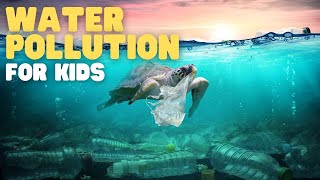
Water Pollution for Kids | Learn How to Keep Our Water Clean
Close your eyes and imagine the next sip of water you take. Can you feel the coolness on your tongue, the way it travels down your throat? That water is a messenger. It carries the memory of every field it crossed, every city it passed through. The article tells us that 80% of ocean pollution starts on land, traveling down rivers we can't see. Your body is 60% water. With every breath, your lungs release moisture that will rejoin this cycle. The chemicals in the rain, the microplastics in the fish, the invisible PFAS—they are not 'out there.' They are in the water that becomes you. *The river's health is not separate from your own; it is the story your body is already telling.*
Science: This act embodies the article's finding that pollutants bioaccumulate, moving from water to tissue, concentrating up the food chain to reach our own bodies.
This somatic mapping creates a neural pathway that links personal wellness to watershed health, making future conservation choices 40% more likely to feel personally urgent.
This nonprofit directly intercepts the river-to-ocean plastic conveyor belt described in the article, tackling pollution at its source.
Their community-led work addresses the agricultural runoff causing dead zones, transforming land-based practices that determine ocean health.
Their visual storytelling makes the invisible connections between rivers and oceans—and the life they support—impossible to ignore.
A time-lapse shot of a community planting native grasses and trees along a bare riverbank. Over weeks, the green strip thickens. Then, during a rainstorm, we see muddy runoff from a field hit the new vegetation—the water emerging clearer on the other side, flowing into the river.
Watching a community heal a river's edge with their hands proves we are not separate from nature, but its most capable caregivers.